The Knock, the Rattle, and the Guy Who Actually Knew What It Meant

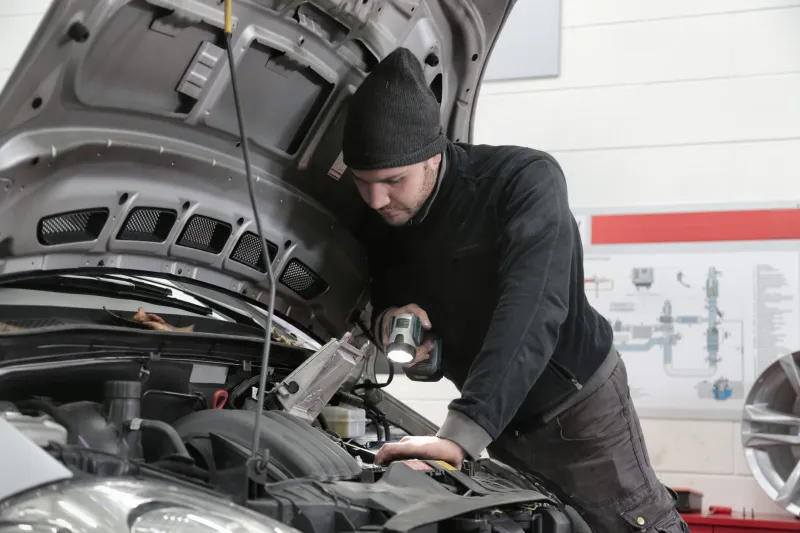
There's a particular kind of mechanic who doesn't really exist anymore. You'd pull into his bay, and before you'd finished explaining the problem, he'd already be listening — head slightly tilted, eyes somewhere in the middle distance — hearing something in your engine that you couldn't quite name but knew wasn't right. He'd say something like "that's your valvetrain" or "sounds like a rod knock" and he'd be correct. Every time.
He wasn't guessing. He'd spent years building a mental library of automotive sounds, and your car was speaking a language he'd been studying his whole working life.
That kind of knowledge is increasingly rare now. Not because mechanics got worse, but because the conversation changed.
When Cars Talked and Drivers Listened
For most of the twentieth century, the relationship between an American driver and their vehicle was fundamentally sensory. You didn't read about problems — you heard them, felt them, sometimes smelled them before they became serious. A faint shimmy in the steering wheel at highway speed meant one thing. A grinding sensation when you hit the brakes meant another. A high-pitched squeal from under the hood on a cold morning told you exactly where to look.
Drivers who paid attention developed genuine mechanical intuition. They couldn't necessarily fix the problem themselves, but they could describe it precisely to someone who could — and that description was the diagnosis. "It knocks when I accelerate from a stop" or "it pulls left when I brake" was enough information for an experienced mechanic to form a strong theory before turning a single wrench.
This wasn't a special skill. It was just what knowing your car felt like.
The Mechanic as Translator
The mechanics of that era occupied a unique cultural role. They were translators between machines and the people who depended on them. A good one could walk through a parking lot and hear things — a fan belt starting to wear, a wheel bearing that had maybe another month left, an exhaust leak that the owner hadn't noticed yet.
Diagnostic equipment existed, but it was limited. Compression testers, timing lights, vacuum gauges — these were useful tools, but they confirmed what a skilled ear had already suspected. The human element was irreplaceable because the technology wasn't sophisticated enough to replace it.
Small-town garages across America ran on this model for generations. The mechanic knew your car almost as well as you did — sometimes better — because he'd worked on it for years and had developed a feel for its particular quirks. He remembered that your '68 Impala always ran a little rich in cold weather and that the idle needed adjustment every spring.
That relationship, personal and accumulated over time, was a form of knowledge that lived nowhere except in someone's head.
The Computer Takes Over
The shift began with the introduction of onboard diagnostics. Early systems appeared in the 1980s, but the real turning point was OBD-II, the standardized diagnostic protocol that became mandatory on all US passenger vehicles sold after 1996. Suddenly, every car was generating a continuous stream of data about its own performance — and that data could be read by any shop with the right scanner.
The check engine light, that amber glyph that has caused more low-grade anxiety than perhaps any other invention in automotive history, became the primary communication channel between car and driver. Something is wrong. Or possibly not that wrong. It's hard to say. Please consult a professional.
For shops, the scanner became the first step in any diagnosis. Plug it in, pull the codes, let the software point you toward the problem. It's faster, often more accurate for complex electronic issues, and requires less of the intuitive expertise that older mechanics spent decades developing.
What Got Lost
Here's the honest accounting: modern diagnostic technology has made cars more reliable and repairs more precise. Intermittent electrical gremlins that would have stumped a 1975 mechanic for days can now be isolated in minutes. Emissions systems that are far too complex for human intuition to navigate are handled efficiently by computers that speak the car's native digital language.
But something real disappeared in the transition.
Drivers today are largely passive participants in their own vehicle's health. The car monitors itself and reports back when something crosses a threshold. Until that light comes on, there's no particular reason to pay attention to what the car is doing. And when the light does come on, the response is almost always the same: take it somewhere and have them plug in the scanner.
The sensory connection — the habit of listening, feeling, noticing — has atrophied for most American drivers. Ask someone under thirty to describe what their car sounds like when it's running well and you'll often get a blank look. That's not a criticism. It's just that the system no longer requires that knowledge.
Mechanics feel this too. The older ones will tell you that young technicians coming out of training programs are excellent with software and diagnostic tools but sometimes struggle when a problem doesn't generate a code — when the car is telling you something through vibration or sound that the computer hasn't registered yet. Reading those signals is a skill that has to be deliberately taught now, because it no longer develops naturally.
The Language That's Still There
Your car still makes sounds. It still vibrates and pulls and occasionally smells like something you should probably investigate. The mechanical reality hasn't changed that much. What's changed is whether anyone is listening.
There's a case to be made for relearning that language, even a little. Not to replace the scanner, but to complement it. A driver who notices that their car has started running slightly rougher at idle, or that the steering feels different than it did last month, is going to catch problems earlier and communicate better with whoever fixes them.
The mechanic who could diagnose by sound wasn't magical. He'd just paid attention long enough to know what normal felt like. That's still possible. The car is still talking. Most of us just stopped listening.