Gone Flat: The Slow, Silent Disappearance of America's Most Trusted Backup Plan
Gone Flat: The Slow, Silent Disappearance of America's Most Trusted Backup Plan
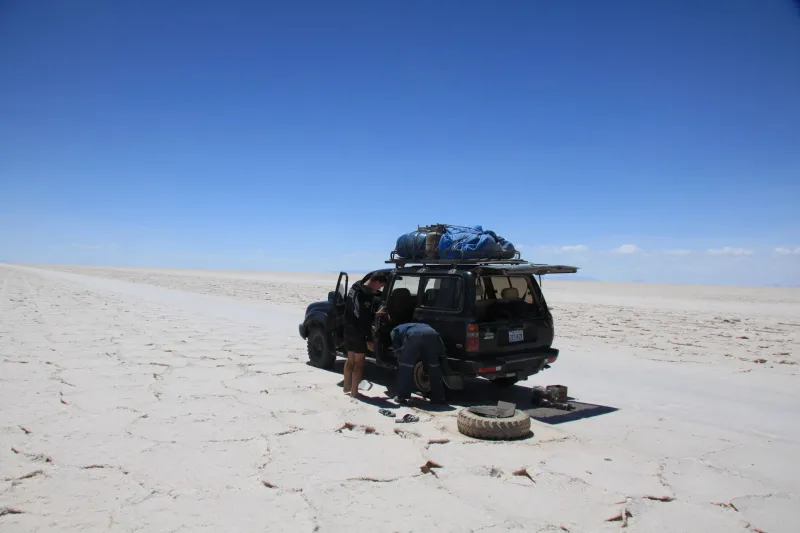
Somewhere in America right now, someone is standing on the shoulder of a highway staring at a flat tire, holding their phone, and realizing with a sinking feeling that there is no spare in their trunk. There's a little can of foam sealant. There's an app for roadside assistance. There might be a tire inflator that plugs into the cigarette lighter.
But there is no spare.
This is new. This is strange. And most drivers have no idea it happened.
The Spare Was Sacred
For the better part of a century, the spare tire wasn't optional equipment — it was as fundamental to an American car as the steering wheel or the gas pedal. You didn't question it. You didn't opt out of it. It was simply there, sitting in the trunk or mounted on the rear of your truck or SUV, waiting with the patient reliability of something that knew its moment would come.
And that moment always came. Nails, glass, potholes, blowouts at speed — the American road has always found ways to ruin a perfectly good tire. The spare was the answer. A universal, mechanical answer that required no signal strength, no subscription, and no waiting. You pulled over, got out the jack and the lug wrench, and you handled it. Maybe it took twenty minutes. Maybe you got your hands dirty. But you drove away.
Knowing how to change a tire was a basic life skill, passed from parent to child in driveways across the country. It was one of those practical competencies — like checking the oil or jumping a dead battery — that marked the line between someone who drove a car and someone who actually knew how to deal with one.
When the Donut Showed Up
The full-size spare began losing ground in the 1980s, replaced in many vehicles by the compact spare — the smaller, narrower temporary wheel that became universally known as the "donut." It wasn't a perfect solution. Donuts were rated for limited distances and lower speeds, usually around 50 miles per hour and no more than 50 to 70 miles of use. But they fit in a smaller space, weighed less, and cost less to manufacture. For automakers chasing fuel efficiency standards and cost reduction, they were an attractive compromise.
Drivers accepted them without much protest, mostly because the donut still meant you could get yourself off the road and to a tire shop under your own power. It was a degraded version of the original promise, but the promise was still basically intact: a flat tire is an inconvenience, not a crisis.
The Foam Can Arrives
The next step was more radical, and it happened gradually enough that most people didn't notice until it was done. Starting in the 2000s and accelerating sharply through the 2010s, automakers began shipping new vehicles with no spare at all — not even a donut. In their place: a small compressor and a can of tire sealant, often branded with names like "Tire Mobility Kit" or "Run-Flat Repair System."
The pitch was practical enough. Spare tires are heavy. They take up trunk space. Most drivers go years between flats, so why carry the weight and sacrifice the cargo room? The foam kit handles the majority of slow-leak scenarios, and run-flat tires — which can be driven for limited distances even after losing pressure — handle the rest. Roadside assistance is a phone call away for anything beyond that.
The logic is sound, as far as it goes. But it rests on a set of assumptions that don't always hold up on the side of a rural highway at midnight.
What the Foam Can't Fix
Tire sealant kits have real limitations that the marketing materials tend to underemphasize. They don't work on blowouts — only on slow punctures in the tread area. They don't work on sidewall damage, which is common with pothole strikes. They can sometimes damage the tire pressure monitoring sensors inside the wheel. And after you use them, you're still driving on a compromised tire that needs professional attention soon.
Run-flat tires solve some of these problems but create others. They're significantly more expensive to replace, harder to find at smaller tire shops, and deliver a noticeably harsher ride due to their stiffer sidewall construction. When they fail, they fail completely — and you still need a tow.
Roadside assistance is the final fallback, and it works reasonably well — until you're somewhere with no cell signal, or the wait is two hours, or you're late for something that actually matters.
What the Spare Really Represented
The disappearance of the spare tire is, on one level, a straightforward story about weight reduction, cost savings, and trunk space. But it's also a small cultural marker worth pausing on.
For most of the twentieth century, the American relationship with the automobile was built on a certain kind of self-sufficiency. You owned the machine. You understood its basics. When something went wrong, you dealt with it — not because you were a mechanic, but because you were expected to be a competent adult who could handle ordinary mechanical trouble.
The spare tire was the physical embodiment of that expectation. It said: something will go wrong eventually, and when it does, you will be equipped to handle it yourself, without asking anyone for help.
The foam can says something different. It says: something might go wrong, but don't worry — there's a service for that.
Neither approach is wrong, exactly. But they represent genuinely different ideas about what it means to be on the road, and what we expect of ourselves when we get there.
Today, roughly one in three new vehicles sold in the United States ships without a full-size spare. Many come without any spare at all. Most buyers don't know this until they're already standing on the shoulder, staring at the flat, reaching for the little can of foam.
The spare tire didn't make headlines when it left. It just quietly stopped showing up. And most of us didn't notice until we needed it.