Quarters, Booths, and the Guy Who'd Had Enough of Your Day: The Vanishing World of the Toll Plaza
Quarters, Booths, and the Guy Who'd Had Enough of Your Day: The Vanishing World of the Toll Plaza
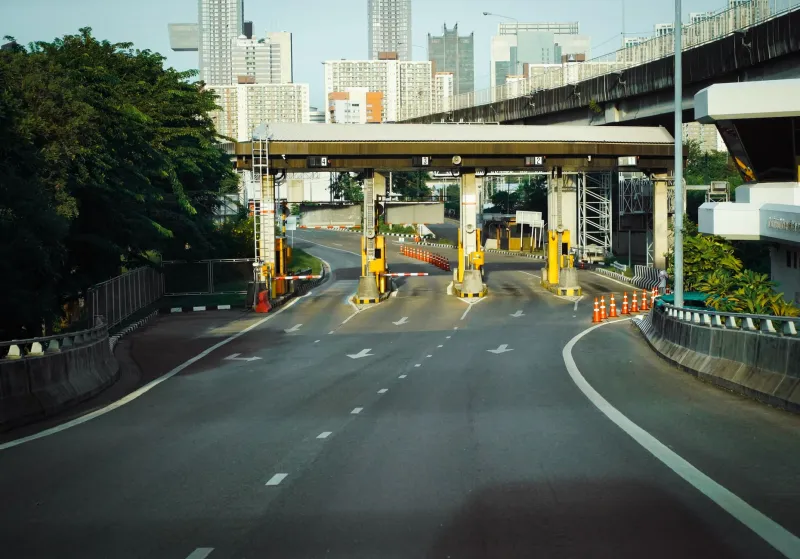
There's a moment that used to define long-distance driving in America, and almost nobody misses it — but almost everybody remembers it. You'd be cruising down the turnpike, radio humming, maybe a half-eaten bag of chips on the passenger seat, and then you'd see it: the toll plaza. A row of orange-and-white striped booths stretching across all lanes, every car slowing to a near-stop. And suddenly, you were scrambling.
Where were those quarters? Were they still in the cupholder? Did you already spend them on that vending machine at the rest stop?
For most of American driving history, that scramble was just part of the deal.
The Ritual Nobody Remembers Asking For
Toll roads in the United States go back further than most people realize. The Pennsylvania Turnpike — often called America's first superhighway — opened in 1940, and it charged tolls from day one. By the postwar boom years, toll roads and bridges had spread across the Northeast, Midwest, and beyond. The New Jersey Turnpike, the Ohio Turnpike, the Illinois Tollway — these weren't just roads. They were entire systems built around the idea that drivers would pay as they went, in cash, to a real human being sitting in a glass booth.
 Photo: New Jersey Turnpike, via sm.ign.com
 Photo: Pennsylvania Turnpike, via s7d9.scene7.com
And for decades, that's exactly how it worked.
You pulled up, rolled down your window, and either dug through your center console for exact change or handed over a bill and waited for the attendant to make change. The whole transaction took maybe thirty seconds — but multiply that by hundreds of cars, and toll plazas became serious bottlenecks. On holiday weekends, the backup could stretch for miles. Thanksgiving on the New Jersey Turnpike wasn't just traffic. It was a slow-motion negotiation between millions of Americans and an army of toll collectors who had seen it all.
Paper Tickets and the Long Game
Not every toll system worked on a flat-rate basis. Many of the longer turnpikes used a ticket system that made the whole experience feel almost bureaucratic. You'd pull a paper ticket from a machine at the entry ramp — a thin strip of cardstock with your entry point stamped on it — and then carry that ticket with you for the entire length of your drive. When you finally exited, a toll collector would calculate your fare based on how far you'd traveled, take your ticket, and collect the appropriate amount.
Lose that ticket? You paid the maximum fare. No exceptions. No appeals. The collector had heard every story.
The tickets themselves were oddly satisfying objects — small, slightly official-looking, proof that you were somewhere in the middle of a journey. Kids would hold onto them. Parents would tuck them in the visor. And occasionally, someone would hand over a crumpled, coffee-stained version that had survived the entire trip rattling around in a jacket pocket.
The Token Era
Some toll systems tried to speed things up by issuing tokens — small metal coins, often slightly larger than a quarter, stamped with the name of the authority running the road. The Port Authority of New York and New Jersey used them for decades on its tunnels and bridges. Regular commuters would buy tokens in bulk, keeping rolls of them in the glove compartment or stashed in a dedicated spot in the console.
Tokens were their own subculture. You could buy them at the toll plaza itself, or at certain newsstands and transit offices. Losing your token supply before a busy week of commuting was a minor personal crisis. Finding an old token in a coat pocket was like discovering forgotten money — except it only worked in one very specific place.
For commuters who crossed the same bridge or tunnel every single workday, the token handoff became almost meditative. A practiced flick of the wrist into the basket, the satisfying clunk of metal on metal, a nod from the collector if they recognized you. It was a small human ritual embedded in the middle of an otherwise anonymous commute.
The Collectors Themselves
Toll collectors don't get much historical credit, but they occupied a genuinely strange social position. They spent eight-hour shifts in a booth barely larger than a closet, handing change to thousands of strangers, absorbing the frustration of everyone who was running late, and occasionally absorbing something worse — exhaust fumes, extreme heat, bitter cold. The booths were air-conditioned and heated in later years, but it was never a glamorous job.
And yet regulars often developed real rapport with the collectors on their usual routes. A quick exchange about the weather. A joke about the traffic. A shared eye-roll when someone tried to pay for a $1.50 toll with a twenty-dollar bill during the morning rush.
Those collectors were, in a small way, part of the social fabric of the road. They were the last human checkpoint before you disappeared back into the anonymous flow of the highway.
Then E-ZPass Changed Everything
The first electronic toll collection systems started appearing in the late 1980s and early 1990s. E-ZPass launched in the New York and New Jersey area in 1993, and it spread quickly across the Northeast and Midwest. The concept was simple: a small transponder mounted on your windshield communicated with a sensor overhead, your account was charged automatically, and you never had to slow below highway speed.
The booths didn't disappear overnight. For years, toll plazas operated with a split — cash lanes on one side, E-ZPass lanes on the other. The contrast was stark. The electronic lane moved at full speed. The cash lane crept forward one car at a time. It didn't take long for drivers to do the math.
Today, many toll roads have eliminated cash entirely. Some have removed the physical booths altogether, replacing them with overhead gantries that photograph your license plate and mail you a bill. You drive through at full speed, and somewhere in a processing center, a computer notes your passage. The whole transaction is invisible.
What We Actually Lost
It would be easy to say nothing was lost. And in practical terms, that's mostly true — electronic tolling is faster, cheaper to operate, and less frustrating for everyone involved. Thousands of toll collector jobs have disappeared, which is a real cost that tends to get glossed over in the enthusiasm for efficiency.
But there's something else, harder to quantify. The toll plaza was one of the last points on the American highway where the road actually slowed you down and made you acknowledge something. You were passing through. You were using something that cost money to build and maintain. A person looked at you and took your payment and gave you change.
Now you just drive. The charge shows up on your credit card statement a few days later, buried between the streaming service and the grocery run. Most people never even notice it.
The road got faster. The transaction got cleaner. And one more small human moment got quietly optimized out of existence.