Rust, Pride, and Reserved Spots: When the School Parking Lot Was Where America Grew Up
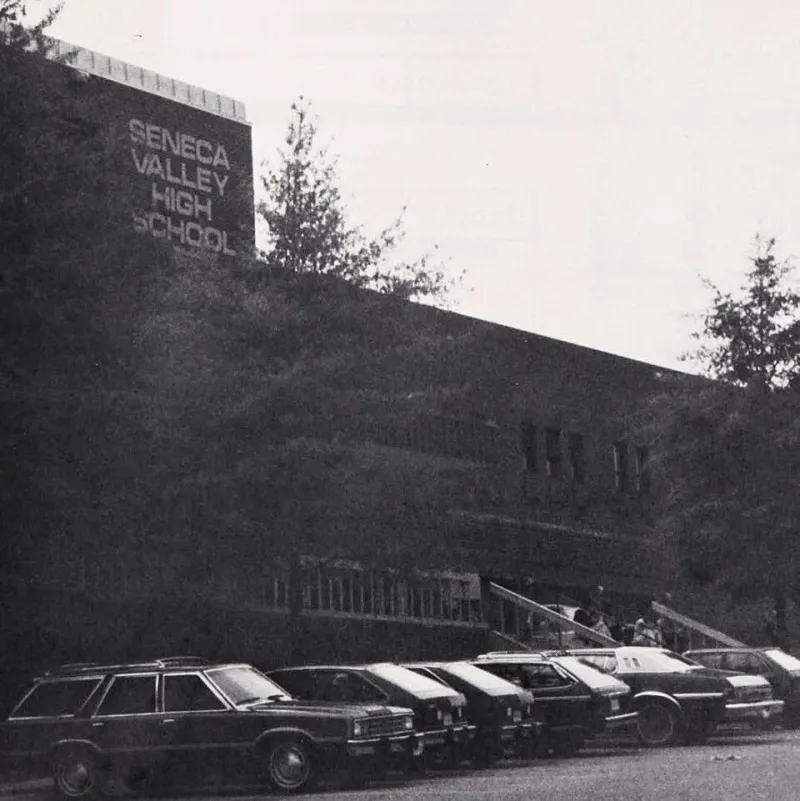
Photo: Michael R., Public domain, via Wikimedia Commons
Somewhere in a suburb outside Columbus, or Tulsa, or Sacramento, there's a high school parking lot that used to mean everything. Not the building. Not the football field. The parking lot. That cracked asphalt rectangle where juniors and seniors pulled in every morning and, in doing so, announced something about who they were and where they were going.
The car you drove to school in 1984 was a statement. Not always a flattering one — sometimes it was a rusted-out 1972 Datsun with a passenger window that wouldn't close all the way — but it was yours, and it was there, and it said something. That was enough.
The Lot as Social Architecture
If you were a teenager in America during the 1970s, 80s, or early 90s, the school parking lot had a social logic as clear and legible as any cafeteria seating chart. The back rows near the gym were for seniors. Juniors took what was left. The spots closest to the main entrance were quietly understood to belong to whoever had the most visible vehicle — not necessarily the nicest, but the most talked-about.
Cars were sorted by personality as much as make and model. The muscle car guys clustered near the fence. The kids who'd spent the summer under the hood of something old and American occupied their own corner of the lot, hoods occasionally popped for inspection during lunch. The girl who drove her mom's Volvo parked it without ceremony and didn't think twice. The guy who'd saved two summers of lawn-mowing money for a used Camaro thought about it every single day.
None of this was organized or official. It emerged organically from the fact that cars, for American teenagers of that era, were genuinely loaded with meaning.
What the License Actually Meant
Getting your driver's license at 16 was, for most of the 20th century, one of the clearest rites of passage in American adolescence. It wasn't just about transportation — it was about the particular kind of freedom that only physical mobility can provide. The freedom to leave. To show up somewhere on your own terms. To exist in a space that wasn't school or home.
The car made possible a whole geography of teenage life that simply couldn't exist without it. The drive-in. The late-night diner run. The parking lot of the 7-Eleven where everyone seemed to end up on Friday nights for reasons nobody could fully explain. The long, aimless drives down county roads with the windows down and the radio up, going nowhere specific because going nowhere specific was, for a 17-year-old with a tank of gas, an act of profound liberty.
Parents understood this. They'd lived it themselves. Handing over the keys for the first time was a milestone that carried genuine emotional weight — for the teenager and for the adults watching them pull out of the driveway alone for the first time.
The Numbers Started Dropping
Somewhere around 2008, the trend lines began shifting in ways that researchers and transportation planners started noticing. The percentage of American teenagers with driver's licenses, which had held relatively steady for decades, began declining. By the mid-2010s, the drop was pronounced enough to generate academic papers and news coverage.
In 1983, roughly 46% of 16-year-olds in the United States had a driver's license. By 2018, that number had fallen to around 25%. Among 17-year-olds, the decline was similarly steep. The generation that grew up with smartphones, social media, and eventually Uber and Lyft was, in aggregate, in significantly less of a hurry to get behind the wheel.
The reasons are layered. Licensing costs and insurance rates have climbed considerably. Graduated licensing laws, introduced across most states during the 1990s and 2000s, extended the process and added restrictions that made early driving less immediately liberating. Urban density among younger Americans reduced the practical necessity of car ownership. And then there's the phone — a device that delivers much of what a car once provided: connection, autonomy, the ability to be somewhere else without physically going there.
A Different Kind of Independence
It would be easy to frame this as generational decline — kids today don't want what kids used to want — but that's probably too simple. The independence that a car represented in 1987 was real, but it was also born of necessity. There was no other option. If you wanted to see your friends on a Saturday night, someone had to have a car. If you wanted to get to a job, you probably needed to drive. The license wasn't just symbolically important; it was practically essential in a way that it simply isn't for every teenager today.
Rideshare apps work. They're genuinely convenient. A 16-year-old in a city with decent Uber coverage has real mobility options that didn't exist before. That's not nothing. That's actually a significant quality-of-life improvement for teenagers in dense areas, and it's worth acknowledging honestly.
But something changed in the texture of adolescence when the car stopped being the primary vehicle — literal and metaphorical — for teenage independence. The parking lot was never really about the cars. It was about the fact that those cars represented a decision, a commitment, a small act of becoming. You saved the money, or your parents helped you find something affordable, and you learned to maintain it and navigate with it and occasionally embarrass yourself in it, and that whole process was part of growing up in a way that requesting a ride on an app simply isn't.
The Lot Still Exists
The high school parking lot hasn't disappeared. It's just quieter now. Fewer students. More empty spaces. The cars that are there tend to be newer and more anonymous — sensible used Corollas and Civics, practical rather than expressive, chosen for reliability rather than identity.
The kids who do drive to school today still feel something about it. The license still matters. The first solo drive is still a moment. But the parking lot has lost its role as social theater, as the stage where American teenagers once performed the first draft of who they were going to become.
That performance has moved online, which is faster and reaches more people and requires no parallel parking. Whether it does the same work for the people performing it is a question worth sitting with.