Thumbs Out, Worries Gone: The Forgotten Era When Strangers Shared the Road
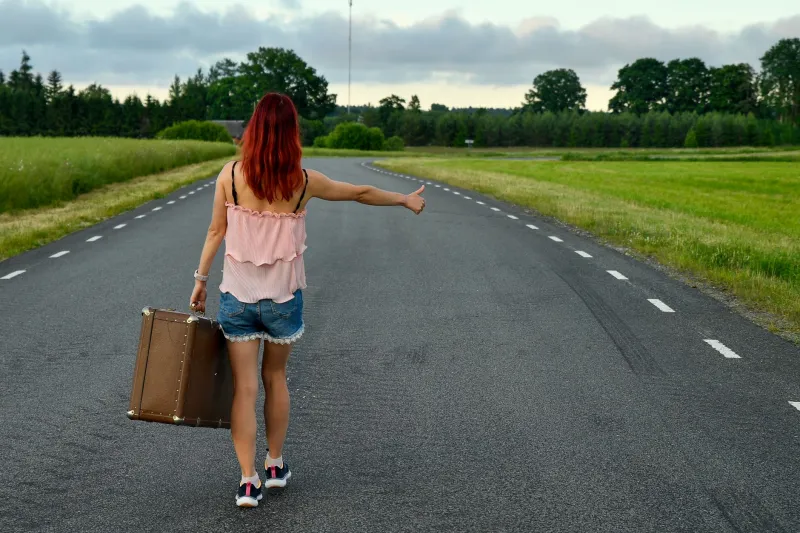
Picture this: a college kid in 1968 stands at the edge of a two-lane highway somewhere in Ohio, duffel bag at his feet, thumb extended toward the passing traffic. Within ten minutes, a Chevy Impala pulls over. The driver is a middle-aged salesman heading toward Columbus. They talk about baseball for ninety miles, then part ways with a handshake. Nobody thought twice about it.
That scene feels almost fictional today. Not because it didn't happen — it happened constantly, for decades — but because the cultural scaffolding that made it feel safe and sensible has completely collapsed. Hitchhiking didn't just fade out. It went from ordinary to unthinkable in the span of a single generation.
The Golden Age of the Thumb
Hitchhiking in America has roots that stretch back to the Great Depression, when millions of men moved across the country looking for work and had no other way to get there. By the 1940s, it was so common that the U.S. military actively encouraged servicemen to hitchhike during wartime to conserve fuel. Gas rationing made car-sharing a patriotic act, and the habit stuck long after the war ended.
Through the 1950s and into the 1970s, hitchhiking was a legitimate mode of transportation for students, workers, and anyone who needed to cover distance without money. College campuses had informal hitchhiking boards where people posted their destination and hoped for a ride. AAA acknowledged it in travel guides. Some rural communities treated it as a kind of informal public transit system.
The numbers backed up the casual attitude. Tens of millions of Americans hitchhiked at some point during the postwar decades. Surveys from the early 1970s suggested that a significant portion of the adult population had either hitched a ride or given one within the previous year. It wasn't a fringe behavior. It was just something people did.
What Changed — and When
The shift didn't happen overnight, but it accelerated sharply in the mid-1970s. A series of high-profile crimes involving hitchhikers — both drivers and riders as victims — generated enormous media attention. True crime was becoming a cultural fixture, and the hitchhiker became a recurring figure in the emerging genre: either a predator or a victim, never just a person trying to get somewhere.
California banned hitchhiking on freeways in 1969. Other states followed with their own restrictions. Law enforcement agencies began running public awareness campaigns warning drivers not to pick up strangers. The imagery shifted. Where hitchhikers had once been portrayed in pop culture as free-spirited and adventurous — think Jack Kerouac, think the endless road — they started appearing in horror films and crime dramas as threats.
The 1980s completed the transformation. The rise of cable news and 24-hour crime coverage meant that isolated incidents got amplified into national fears. Parents who had hitchhiked freely in their youth began telling their children it was dangerous. By the time the internet arrived, the warning had calcified into conventional wisdom: never pick up a stranger, never get in a stranger's car.
The Statistics Nobody Talked About
Here's the part that complicates the story. The actual data on hitchhiking-related crime was never as dramatic as the cultural panic suggested. Researchers who studied the phenomenon in the 1970s and 1980s found that hitchhiking incidents, while real and sometimes tragic, were statistically rare relative to how many millions of rides were exchanged each year. The risk existed, but it was neither random nor as common as the fear implied.
What the data couldn't compete with was narrative. A single terrible story, repeated and amplified, reshaped behavior more effectively than any statistical reassurance could counteract. Fear doesn't run on probability. It runs on vividness.
At the same time, actual changes in American life were making hitchhiking less necessary. Cars became more affordable. Interstate highway systems expanded. Greyhound routes multiplied. Eventually, discount airlines made long-distance travel accessible to people who never could have afforded it before. The practical case for hitchhiking weakened just as the cultural case against it strengthened.
The Cell Phone as the Final Nail
If one technology deserves credit for making hitchhiking feel permanently obsolete, it's the smartphone. Before mobile phones, breaking down on a rural highway meant you were genuinely stranded. Flagging down a passing driver wasn't just convenient — it was sometimes the only option. That shared vulnerability was part of what made the hitchhiking exchange feel natural. You helped people because someday you might need help too.
Once everyone carried a device capable of summoning a tow truck, calling a friend, or booking a rideshare from the side of the road, the logic evaporated. Uber and Lyft took what hitchhiking offered — a stranger's car going roughly where you needed to go — and rebuilt it with background checks, GPS tracking, digital payment, and mutual ratings. The appeal of the chance encounter was replaced by the comfort of the verified transaction.
Ridesharing is, in a sense, hitchhiking with paperwork. The fundamental exchange is identical. The difference is that every variable has been quantified, recorded, and made accountable. Whether that's progress or just managed anxiety depends on your perspective.
What the Road Lost
It would be easy to romanticize hitchhiking in ways that ignore the genuine risks involved. Those risks were real, and no amount of nostalgia should minimize them. But something did disappear when the practice died, and it's worth naming.
Hitchhiking forced interaction between people who would never otherwise have met. A trucker from rural Alabama giving a ride to a grad student from Boston. A retired teacher picking up a young woman heading home for a family emergency. Those ninety-mile conversations happened millions of times, and they created a kind of accidental social fabric — brief, unrepeatable connections between strangers who shared nothing but a direction.
The road used to be a place where America mixed. Now we travel in sealed, climate-controlled bubbles, connected to everyone we already know and insulated from everyone we don't. That's safer. It's also lonelier in ways we've mostly stopped noticing.