Are We There Yet? The Quiet Death of Boredom in the American Family Car
Somewhere between the invention of the minivan and the invention of the tablet, the American family road trip stopped being an exercise in patience and became something closer to a mobile living room. Kids used to dread long drives. Now they barely notice them.
That shift — subtle, gradual, and almost entirely unremarked upon — might be one of the most significant changes in everyday family life over the last four decades. Not because of what we gained, but because of what quietly disappeared.
The Silence That Used to Fill the Car
If you grew up in the 1970s, 80s, or early 90s, you know the feeling. The hum of the engine. The blur of highway scenery. Maybe an AM radio station fading in and out. Maybe your parents talking in low voices up front about something you weren't supposed to understand. And you, wedged between a sibling and a cooler full of sandwiches, with nothing to do but think.
That was the car ride. That was just how it was.
Boredom wasn't a problem to be solved back then — it was a feature of the journey. Kids invented games out of nothing. License plate bingo. Counting Volkswagen Beetles. Making up elaborate backstories for the family in the station wagon two lanes over. You stared at clouds and let your mind drift in ways that are genuinely hard to replicate today. The window was your screen, and the content was whatever happened to be out there.
The only real entertainment technology was the occasional road trip cassette — maybe a comedy album your dad liked, or a story tape your mom bought at the library. If you were lucky, there was a portable AM/FM radio with headphones that got terrible reception past the first hundred miles.
Nobody complained. Or rather, everyone complained, but nobody expected it to be different.
The Slow Arrival of the Screen
The first crack in the quiet came in the late 1990s with portable DVD players — those chunky, battery-hungry devices that parents strapped to headrests like a gift from a more civilized future. Suddenly, kids could watch The Lion King somewhere in rural Ohio without anyone having to stop the car. It felt like a miracle.
But that was just the beginning.
By the mid-2000s, factory-installed rear-seat entertainment systems started appearing in minivans and SUVs. Fold-down screens, wireless headphones, DVD changers. The car was becoming something new — not just a vehicle, but an environment designed to manage the passenger experience from the moment you left the driveway.
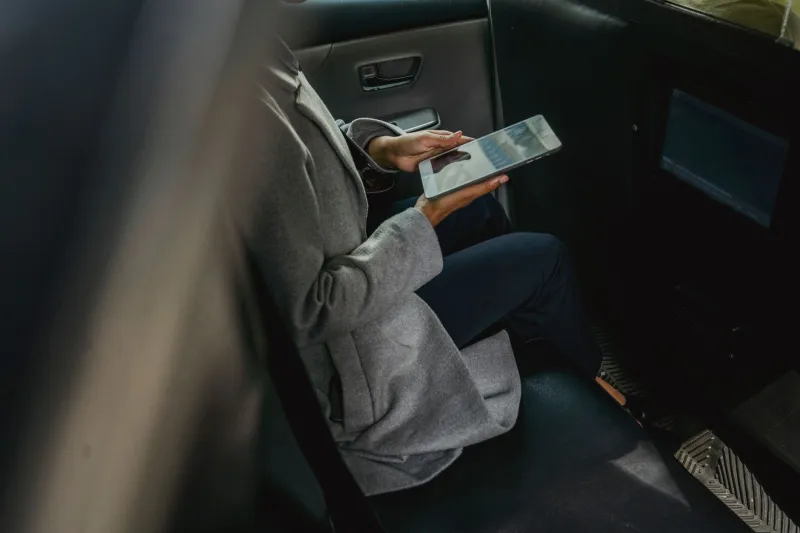
Then came the iPad. Then came streaming. Then came individual screens, individual playlists, individual noise-canceling headphones for kids who are four years old.
Today, a family of four can travel 600 miles in near-total silence, each person sealed inside their own digital bubble. The kids are watching different shows. The parents are listening to different podcasts. Nobody is looking out the window. Nobody is bored. Nobody is talking.
What the Research Suggests (And What Parents Already Know)
Child development researchers have pointed out for years that unstructured time — including boredom — plays a meaningful role in how kids develop creativity, emotional regulation, and imagination. When children have nothing external to focus on, they're forced to generate something internal. That's not nothing. That's actually quite a lot.
The long car ride used to be accidental training in exactly that skill. You didn't choose to be bored. You just were. And then, because there was no alternative, you figured out how to be okay with it.
Today's car rides don't ask that of kids at all. The transition from driveway to destination is now managed almost entirely by content. And while it's undeniably more comfortable — for kids and for parents — something that used to happen naturally in those quiet miles simply no longer gets the chance.
Parents who lived through both eras often describe a strange nostalgia for the old version, even as they reach for the tablet charger without hesitation.
The Memories That Stuck
Here's an interesting thing to consider: ask someone in their 30s or 40s about a memorable road trip from childhood, and they'll almost always describe something that happened outside the car. A weird roadside attraction. A breakdown in the middle of nowhere. A gas station where someone said something funny. A moment of pure, unexpected wonder at a landscape they'd never seen before.
The boredom created space for those moments to land. When you're not already stimulated, the world outside the window has a chance to actually surprise you.
It's harder to be surprised by a mountain range when you're twelve minutes into an episode of something on Netflix.
The Honest Trade-Off
None of this is an argument for forcing kids to stare at cornfields for six hours. Parents today are managing more, working more, and traveling longer distances with less margin for error. Anything that keeps the back seat calm is a genuine quality-of-life improvement, and dismissing that would be easy and unfair.
But it's worth naming what was traded. The car used to be one of the few places where families were genuinely stuck together — no escape, no distraction, just proximity and time. Conversations happened in that space that wouldn't have happened anywhere else. Confessions. Questions. Long silences that eventually became something real.
The road trip hasn't disappeared. But the version where boredom was the engine of connection? That one's mostly gone.
And most families didn't notice it leave.