The Needle Knew Enough: When Your Speedometer Was Honest About Being Wrong
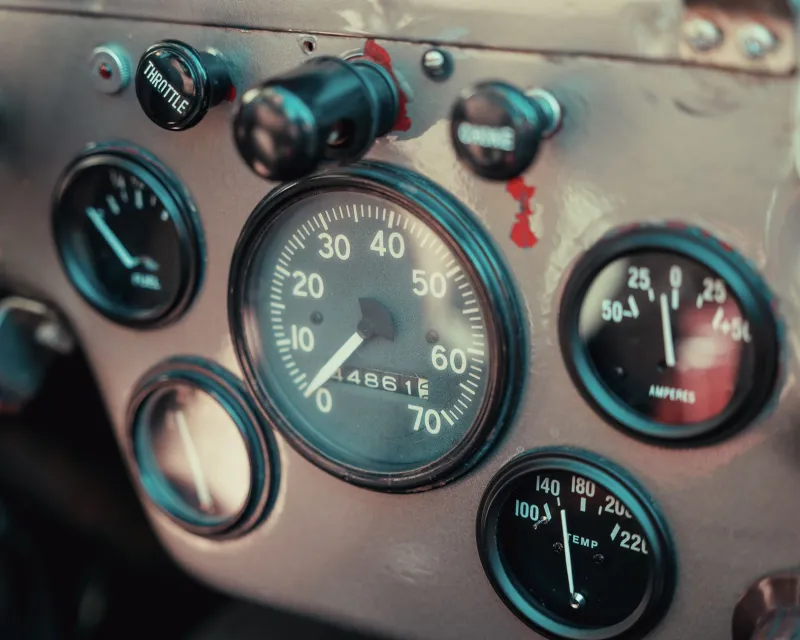
There was something almost reassuring about the old needle. It swept upward when you pressed the gas, hovered with a slight tremor at highway speed, and drifted back down when you lifted your foot. It wasn't perfectly accurate. You probably knew that. Your dad definitely knew that. And somehow, that shared understanding made the whole thing feel more honest.
Today, your dashboard shows a crisp digital number — 67, 72, 81 — and it looks like scientific fact. But underneath that clean readout is a system doing math you'll never see, correcting for variables you've never considered, and presenting the result with a confidence the old mechanical needle never pretended to have.
The Beautiful Imprecision of the Mechanical Age
Analog speedometers worked through a cable connected directly to your transmission or wheel hub. The cable spun, the mechanism translated that rotation into needle movement, and you got a reading. Simple. Mechanical. And yes — off by a margin that was not only common but actually legal.
U.S. regulations historically allowed speedometers to read high by up to 10 percent. Manufacturers took advantage of that buffer, partly to protect themselves from liability and partly because a speedometer that read slightly fast made drivers feel like they were going faster than they were — which most considered a safety feature. If your needle said 60, you might actually be doing 56 or 57. Drivers who paid attention figured this out over time. You learned your car. You knew your needle.
Odometers had their own quirks. Mechanical odometers were driven by the same cable system, which meant tire wear, tire size changes, or even cold weather affecting tire pressure could shift your mileage readings. None of this was a scandal. It was just how things worked, and people understood it at a gut level — the same way they understood that a watch running two minutes fast wasn't broken, just a little optimistic.
When Digital Looked Like Progress
The shift to digital displays began in the 1980s, when automakers started experimenting with electronic instrument clusters. The Cadillac Eldorado got one in 1978. The DeLorean had one. For a while, the blinking red numbers felt futuristic — like driving a spaceship, or at least a very expensive calculator.
Consumers eventually pushed back on the aesthetic, and analog-style gauges returned. But the underlying technology kept evolving quietly. By the time fully digital dashboards became standard equipment in the 2010s and 2020s, the numbers being displayed were no longer coming from a cable. They were coming from wheel speed sensors, GPS receivers, onboard computers, and software algorithms that cross-reference multiple data streams to produce what looks like a simple number.
Your car now knows more about your actual speed than any mechanical system ever could. GPS-corrected readings can be accurate to within a fraction of a mile per hour. Wheel speed sensors sample rotation hundreds of times per second. The math is genuinely impressive.
So why does it sometimes feel less trustworthy?
The Black Box Problem
Here's the paradox: we trust the digital number more completely precisely because we understand it less. When the needle trembled at 65, you had an intuitive sense of the mechanism behind it — a spinning cable, a responding gauge. You could roughly validate it against mile markers, against other drivers, against your own sense of motion. The instrument was transparent in its imprecision.
The digital readout is a black box. Change your tire size without updating your car's settings, and your speed reading is wrong — sometimes significantly. Some manufacturers still calibrate their displays to read slightly high, carrying forward the old conservative tradition, but now doing it invisibly through software. Aftermarket wheels, modified suspension, even certain software updates can affect what number your dashboard shows.
Most drivers have no idea any of this is happening. The number looks authoritative, so it feels authoritative. We've outsourced our skepticism to the display itself.
There's also the GPS layer to consider. Many modern navigation systems show your speed independently of the car's own display — and they sometimes disagree. If you've ever glanced at your phone's GPS speed while driving and noticed it didn't quite match your dashboard, you've seen the seams in the system. Two different methods of calculating speed, two slightly different answers, both presented with total confidence.
What We Lost When We Stopped Calibrating
Drivers who grew up with analog instruments developed a kind of mechanical intuition. You knew if your car was running rough. You knew if the needle was behaving differently than usual. You felt the car as a physical system, and the dashboard was a window into that system — imperfect, but readable.
Modern dashboards are closer to user interfaces than instrument panels. They're designed to be glanced at, not interpreted. The information is processed before it reaches you. That's efficient, and in most cases it's accurate. But it also means the average driver today has less mechanical literacy about their own vehicle than drivers did forty years ago.
When your grandfather said the speedometer was reading a little high, he wasn't guessing. He'd watched it long enough to know. When a modern driver says their speed display seems off, they usually have nowhere to go with that observation — there's no cable to check, no mechanical relationship to trace. It's software. Good luck.
The Number You See Is a Story
None of this means your digital dashboard is lying to you. In most cases, it's more accurate than anything that came before it. The point isn't accuracy — it's understanding.
The old needle was imprecise, but it was comprehensible. It moved in response to something you could picture. The new number is more accurate, but it's the conclusion of a process you're not part of. You receive the answer without seeing the work.
That's a reasonable trade in a world where cars have become extraordinarily complex. But it's worth pausing to notice that we've moved from instruments we understood imperfectly to systems we trust completely — and that those are very different things.