The Accordion Shade and the Fuzzy Dice: When Personalizing Your Car Was a Whole Hobby
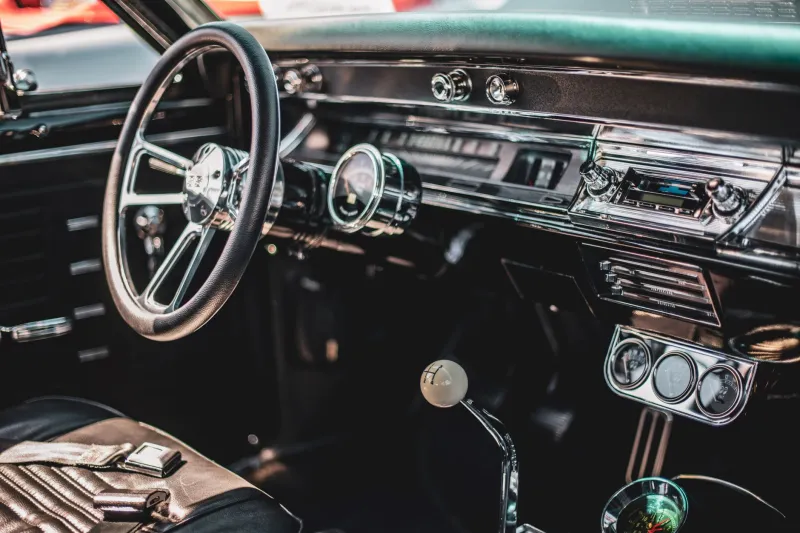
Somewhere in a garage right now — probably yours, possibly your parents' — there is a silver accordion sun shade, slightly bent at one corner, stuffed between a bag of road salt and a spare windshield scraper. You bought it maybe fifteen years ago. You've moved it from one car to the next. You have no memory of purchasing it, but you would never throw it away, because it still works and somehow feels like it belongs to you more than the car does.
That sun shade is a relic. Not because it's old, but because the habit it represents — the regular, casual refreshing of car accessories as a form of both maintenance and self-expression — has quietly faded out of American driving culture. And most of us didn't notice until we tried to find seat covers that actually fit our current car and discovered that the world had moved on without us.
The Accessory Aisle as American Institution
From roughly the 1950s through the early 2000s, the automotive accessory market was a thriving, democratic ecosystem. You could walk into any Kmart, Pep Boys, or AutoZone and find an entire aisle — sometimes two — dedicated to the proposition that your car's interior was a blank canvas waiting for your personal touch.
Seat covers came in dozens of fabrics and patterns. Sheepskin for the luxury-minded. Velour for the comfort-seekers. Neoprene for people who spent time outdoors. In the 1970s and 80s, you could get seat covers with racing stripes, floral patterns, or southwestern geometric designs that made the inside of a Dodge Dart look like a Santa Fe art gallery.
Floor mats were replaced seasonally in many households — rubber mats for winter, carpeted ones for summer. Steering wheel covers were changed when the old ones wore through. Dashboard ornaments, hanging air fresheners, CB radio mounts, window decals, chrome trim pieces — the aftermarket accessory industry generated billions of dollars annually by selling Americans the idea that the car you drove off the lot was merely a starting point.
And the air fresheners. The pine tree. Little Trees, the brand founded in 1952 in Watertown, New York, became one of the most recognizable product silhouettes in American commercial history. Hanging from your rearview mirror, it wasn't just a scent delivery system — it was a signal that someone cared about this interior. Someone was tending to it.
The Interior That Resisted You
Modern car interiors are extraordinary achievements of engineering and design. They're quieter, safer, more ergonomically considered, and more technologically integrated than anything that came before. They're also, almost by design, resistant to personalization.
The shift began gradually as automakers started integrating technology directly into the dashboard — first CD players, then navigation screens, then the enormous touchscreen panels that now dominate center consoles. These integrated systems look sleek and intentional. They also mean there's no natural place for a clip-on fan, a suction-cup phone holder that doesn't block something important, or a decorative trim piece that doesn't clash with the existing design language.
The materials changed too. Older interiors used more fabric, more textured surfaces, more of the kinds of materials that aged visibly and invited replacement. Modern interiors lean heavily on molded hard plastic, piano black trim, and synthetic leather that's designed to look new for years without intervention. There's less visible wear, which means less psychological pressure to refresh anything.
Seat covers, once a universal aftermarket product, now require model-specific fitment to work around side airbags, heated seat sensors, and integrated lumbar controls. Generic covers don't fit properly anymore. The ones that do fit cost nearly as much as a car payment.
The Economics of Trade-In Culture
There's a financial logic underneath all of this that's worth examining. When Americans kept cars for ten, twelve, fifteen years — which was common through the 1980s and into the 1990s — maintaining and personalizing the interior made economic sense. You were going to be in that car for a long time. Making it yours was an investment in daily quality of life.
The average new vehicle loan term in the United States has stretched to over 69 months as of recent years, and many buyers cycle into new vehicles before they've finished paying off the old one. When your mental relationship with a car is already oriented toward the next one, spending forty dollars on new floor mats feels less sensible. You're not nesting. You're waiting.
Leasing accelerated this dynamic even further. If you're leasing, you're explicitly renting someone else's car for three years, and you're contractually required to return it in good condition. Personalization isn't just unnecessary — it's potentially a liability.
The accessory aisle at auto parts stores reflects this shift. It's smaller than it used to be. The seat cover selection is thinner. The novelty items — the fuzzy dice, the dashboard hula dancers, the chrome valve stem caps shaped like skulls — occupy a smaller and smaller footprint. What's growing is the functional category: phone mounts, charging cables, dash cams. Tools for using the car, not for living in it.
What the Sun Shade Actually Represented
The accordion sun shade is still a good product. It keeps your steering wheel from becoming a branding iron in July. It protects your dashboard from UV damage. It costs about fifteen dollars. There's nothing wrong with it.
But the culture that produced it — the culture of regular, engaged, affectionate maintenance of a car as a personal space — has thinned considerably. Cars have become more like appliances and less like expressions of the people who drive them. You don't decorate your dishwasher. You don't put a steering wheel cover on your refrigerator.
That's not necessarily a loss. It might just be clarity — an honest acknowledgment of what a car actually is. But something was alive in the old accessory aisle that's harder to find now. The idea that the space inside your car was worth tending to. Worth refreshing. Worth making your own, even in small, inexpensive ways.
The sun shade you've carried through three different vehicles might be the last artifact of that idea. Don't throw it away just yet.