The Loan Officer Who Remembered Your Father: When Car Financing Was a Conversation, Not a Calculation
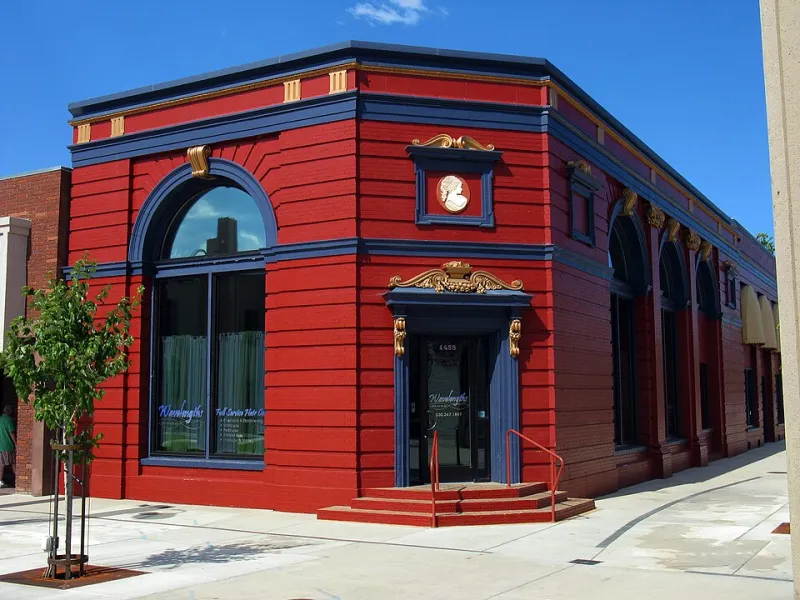
Photo: Publichall, CC BY-SA 4.0, via Wikimedia Commons
Picture this: You're 24 years old. You've got a steady job at the mill, a small savings account, and your eye on a used Buick sitting on a lot two blocks from Main Street. You don't pull out your phone to check your credit score. You don't fill out a form online at midnight. You put on a decent shirt, walk into First National Bank, and ask to see Mr. Kowalski.
 Photo: First National Bank, via www.bankbranchlocator.com
Mr. Kowalski has been making car loans in this town since 1962. He coached your older brother in Little League. He knows your dad pays his bills on time. He's going to ask you a few questions, look you in the eye, and decide whether you're good for it.
That was car financing in America for most of the 20th century. And it was a completely different world.
The Bank Was a Neighbor, Not a Brand
For decades, consumer lending in the United States was a genuinely local affair. Community banks and savings institutions were the primary gatekeepers for auto loans, and the people who ran those institutions were embedded in the same neighborhoods as their borrowers. Loan officers weren't faceless processors — they were recognizable figures who understood the texture of local economic life in ways no spreadsheet ever could.
A loan application was less a data submission and more a conversation. You explained your situation. You described your job, your household, your plans. The officer might ask about your employer, your family, your history with the bank. Character references weren't unusual. A letter from your boss or your pastor could carry real weight.
None of this was particularly efficient. It took time. It required an appointment. Sometimes it required a second visit. But it also meant that a single rough patch — a layoff, a medical bill, a bad year — didn't necessarily define you forever. A loan officer who knew your circumstances could weigh context alongside risk in a way that no automated system ever has.
The Number That Changed Everything
The Fair Isaac Corporation introduced its now-famous scoring model in 1956, but the FICO score didn't become the dominant force in consumer lending until the late 1980s and early 1990s, when Fannie Mae and Freddie Mac began requiring it for mortgage evaluations. Auto lenders followed. By the mid-90s, the three-digit credit score had effectively replaced the loan officer's judgment as the primary lending tool across most of the country.
 Photo: Fannie Mae, via logos-world.net
 Photo: Fair Isaac Corporation, via img-s-msn-com.akamaized.net
The shift made sense from a business perspective. Algorithms are faster, cheaper, and more consistent than human beings. They don't play favorites. They don't get fooled by a charming story or a firm handshake. A national lender processing ten thousand applications a week can't afford the luxury of individual conversations.
But consistency also means inflexibility. A score doesn't know that you spent six months unemployed because your factory closed, not because you were irresponsible. It doesn't know that you've been paying rent on time for a decade, because rent payments historically weren't reported to the bureaus. It doesn't know anything about you, really. It knows patterns of behavior as filtered through a specific set of financial data points — and it treats that narrow picture as a complete portrait.
The Rise of the Financing Portal
Today, the car-buying financing experience has moved almost entirely online. Dealerships partner with networks of lenders. Buyers can get pre-approved from their couch before they ever set foot on a lot. Rates are generated in seconds. The process is genuinely faster and, in many cases, more competitive — you're being evaluated by multiple lenders simultaneously rather than one cautious banker.
For borrowers with strong credit histories, this system works reasonably well. But for people on the margins — younger buyers with thin files, recent immigrants, people recovering from financial hardship — the algorithmic approach can be brutally unforgiving. There's no one to explain your circumstances to. There's no second look. There's just a number, and either it clears the bar or it doesn't.
The subprime auto loan market has grown to fill some of that gap, but often at punishing interest rates that can turn a modest car purchase into a years-long financial burden. It's a different kind of risk than what the old local bank took on — and it frequently shifts that risk entirely onto the borrower.
What Got Lost in the Translation
There's something worth sitting with here. The old system had real flaws. Local lending was susceptible to bias — and not just the subtle algorithmic kind. Loan officers could and did discriminate based on race, gender, and social connections in ways that were deeply unfair and caused lasting harm. The intimacy of community banking wasn't always a virtue. Sometimes it was a closed door with a friendly face on it.
But the solution to human bias doesn't have to be the complete elimination of human judgment. What we've built instead is a system that is technically impartial but practically indifferent — one that processes people rather than understanding them.
Mr. Kowalski is retired now. Or gone. The branch where he worked is either a chain bank with rotating staff and a tablet-based interface, or it's a nail salon. The Buick on the lot two blocks from Main Street is gone too, replaced by a certified pre-owned inventory with QR codes and a finance manager who's really just a salesperson with a different title.
The car loan is faster now. The approval is cleaner. The paperwork is digital. And somewhere in that efficiency, the conversation disappeared — and with it, the possibility that a person who knows you might decide you're worth the risk.