When Your Mechanic Knew Your Car Better Than You Did: The Death of the Neighborhood Fix-It Shop
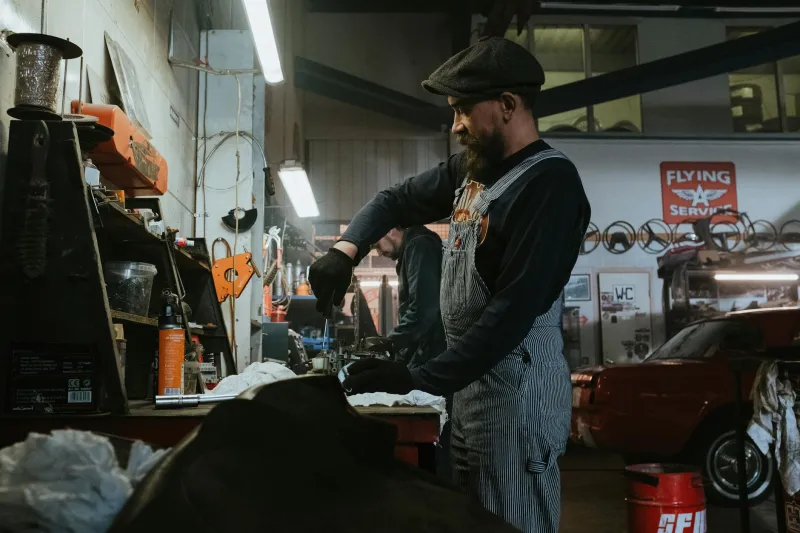
The Era When Any Wrench Would Do
Walk down almost any residential street in America in 1975, and you'd find him: the neighborhood mechanic. He might have been the guy three houses down with the perpetually open garage bay, or the retired Ford technician who fixed cars for beer money on weekends. He didn't have a business license framed on the wall. He had a reputation—earned through years of turning wrenches on Chevrolets, Fords, and Dodges that were simple enough that a determined amateur could understand them.
These mechanics operated with a toolkit that would fit in the bed of a pickup truck. A socket set, a timing light, a carburetor rebuild kit, maybe a compression tester. If your 1968 Chevy Impala wasn't running right, the problem was mechanical, visible, and fixable by someone who understood internal combustion at a fundamental level. A flooded carburetor? Adjust the float. Timing off? Use the timing light and turn the distributor. Spark plugs fouled? Pull them out, gap them, reinstall.
The diagnosis was often the easiest part. You'd describe the symptom—"It won't start in the morning"—and a competent mechanic could walk through the ignition system methodically. Fuel? Check. Spark? Check. Compression? Check. By elimination, you'd find the problem. And you'd fix it yourself or watch someone fix it, learning something in the process.
When Engines Became Computers
Somewhere around 1980, the automotive industry began a quiet revolution. Manufacturers started embedding computers into engines. At first, it was modest—a simple module to manage fuel injection. By the 1990s, every major system in a car was controlled by a networked computer system. Your transmission, your brakes, your emissions, your suspension. The engine itself became less of a mechanical puzzle and more of a black box that communicated in error codes.
This transformation killed the neighborhood mechanic almost overnight.
Today, when that check-engine light illuminates on your dashboard, you're not looking at a simple mechanical failure. You're looking at one of thousands of possible sensor faults, software glitches, or component failures that can only be diagnosed by connecting your car to a specialized scanner—the kind that costs $5,000 to $15,000 and requires proprietary software that manufacturers jealously guard.
Your local mechanic can't afford that equipment. And even if he could, he probably wouldn't have access to the software. Manufacturers have intentionally designed their diagnostic systems to be dealership-exclusive, creating a walled garden where only authorized technicians can perform repairs.
The Dealership Monopoly
This wasn't accidental. It was strategic.
By making repairs inaccessible to independent shops, manufacturers guaranteed a steady stream of customers to their dealership service departments. A Toyota owner with a transmission warning light can't go to Joe's Garage anymore—not really. Joe doesn't have the $50,000 diagnostic setup. He doesn't have access to Toyota's proprietary software. He doesn't have the parts. So the customer ends up at the dealership, paying dealership rates, buying dealership parts, and enriching the manufacturer's service division.
The numbers reflect this shift. In 1980, roughly 70% of automotive repairs were performed by independent mechanics. Today, that number has flipped. The dealership network now controls the majority of repairs on newer vehicles, particularly warranty work and anything involving the vehicle's computer systems.
But it goes deeper than economics. The neighborhood mechanic represented something that's almost vanished from American life: a relationship built on trust, competence, and mutual respect. You knew your mechanic. You knew his work. If he overcharged you, you'd hear about it at the coffee shop. If he did sloppy work, your car would fail and you'd never go back. The social accountability was built into the transaction.
A dealership service advisor is a stranger. You'll likely never see the same person twice. The mechanic who works on your car is behind a wall. You have no relationship, no accountability, no way to verify competence except through a corporate review website. You're trusting a system, not a person.
What We Lost in the Upgrade
The modern car is undeniably more reliable than its 1970s predecessor. A new vehicle will run for 200,000 miles with minimal intervention. A 1977 Chevy was lucky to make it to 100,000 before major repairs became inevitable.
But reliability came at a cost that wasn't printed on any window sticker.
We lost the ability to understand our own vehicles. A curious teenager in 1975 could learn how a car worked by hanging around the neighborhood mechanic's garage. Today's teenager sees a sealed plastic engine cover and a digital dashboard. The mechanical knowledge that used to be common—how to gap spark plugs, adjust a carburetor, time an engine—is now exotic expertise.
We lost self-reliance. Your great-grandfather could fix his own car. Your grandfather could do most repairs. Your father could handle basic maintenance. You probably can't change your own oil without voiding your warranty, and you definitely can't diagnose why your engine warning light is on.
We lost community. The neighborhood mechanic was a fixture of American life for nearly a century. He was where you learned about cars, where you heard local gossip, where you understood that your vehicle was maintained by someone you could see and talk to. The dealership service department is transactional and impersonal.
And we lost control of our own property. You own your car in name only. The manufacturer retains effective control through proprietary software, locked diagnostic systems, and anti-repair restrictions that make it illegal to fix your own vehicle in many cases.
The Irony of Progress
There's a peculiar irony here. Modern cars are better engineered than they've ever been. They're more efficient, more reliable, and safer. Yet for the average driver, they're more mysterious and less controllable than at any point in automotive history.
The neighborhood mechanic is nearly extinct. In his place is a corporate service network designed to extract maximum profit from your vehicle's inevitable maintenance needs. The old system had inefficiencies, sure. Your mechanic might overcharge. He might recommend unnecessary repairs. But he was accountable to you, and you could walk away.
Today's system is efficient, but it's built on information asymmetry and manufacturer control. You can't walk away, because there's nowhere else to go. And you can't even understand what's being done to your car, because the knowledge has been deliberately locked away behind corporate walls.
Maybe that's the cost of progress. Reliability in exchange for autonomy. Efficiency in exchange for understanding. A car that rarely breaks down, driven by an owner who has no idea how it works.
The neighborhood mechanic understood that a car was more than transportation—it was a relationship between owner and machine, mediated by someone who understood both. We've replaced that with a transaction. Whether that was worth the trade-off is a question every car owner should ask themselves.