Mirrors and Blind Faith: How We Used to Reverse Without Seeing Anything
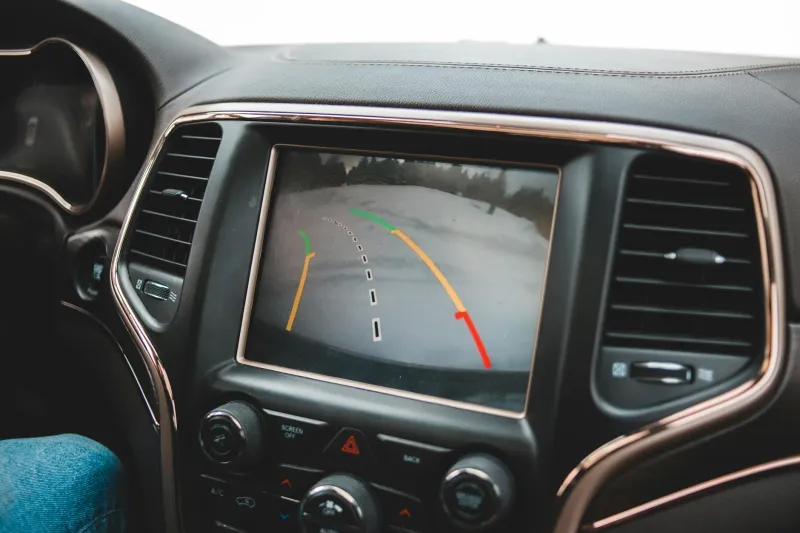
The Age of Blind Reversing
Take a moment and think about reversing a car in 1985. No camera. No proximity sensors. No audible warning if something is in your way. You had three tools: a driver's side mirror, a passenger mirror, and your neck.
The driver's side mirror showed you roughly the lane beside you. The passenger mirror, if you adjusted it correctly, might catch a glimpse of what was immediately behind you. But there were massive blind spots—the areas directly behind the car and along both rear quarters that no mirror could show you. So you did what drivers had done for decades: you craned your neck out the window, twisted around in your seat, and hoped you could see well enough.
This wasn't a perfect system. In fact, it was remarkably dangerous.
Backup accidents were common enough that they barely made local news. A child playing in a driveway. A parked bicycle. Another car. Every year, thousands of backup-related injuries occurred, and hundreds of fatalities. The statistics were so routine they'd been almost normalized—accepted as simply part of driving, like traffic jams or flat tires.
Parents taught their children to stay out of driveways. Insurance companies factored backup collisions into their rate calculations. Emergency rooms treated backup-related injuries as a predictable category of accident. We had collectively decided that this was the cost of vehicle ownership: a certain number of preventable deaths and injuries because we couldn't see what was directly behind us.
The First Small Steps
The earliest automotive safety innovations were modest and slow to gain adoption. In the 1960s, some manufacturers began offering wider-angle mirrors. In the 1970s, convex mirrors became standard, expanding the field of view but distorting the image so much that judging distance became unreliable.
But the real limitation wasn't the mirrors—it was physics. A person can only turn their head so far. You can only see what's in your line of sight. No amount of mirror engineering could overcome the fundamental problem: the human eye can't see behind a solid object.
For decades, the solution was acceptance. You backed up slowly. You got out and looked. You asked a friend to stand behind the car and watch. But you didn't expect the car itself to help you. The idea that a vehicle might actually know what was behind it, and warn you, was the stuff of futuristic movies.
Then, in 2002, Nissan introduced the first backup camera as an optional feature on the Infiniti Q45. It wasn't a mainstream feature. It was a luxury add-on, a curiosity that cost thousands of dollars extra. Most drivers didn't know it existed. The ones who did often couldn't justify the expense.
The Regulatory Turning Point
Everything changed in 2008 when the National Highway Traffic Safety Administration (NHTSA) began seriously investigating backup safety. The data was stark: roughly 292 fatalities and 24,000 injuries occurred annually due to backup accidents in the United States alone. A significant portion of those victims were children—small enough that they couldn't be seen over the trunk of a sedan.
NHTSA proposed a regulation requiring all new vehicles to have either a backup camera or some other means of detecting objects behind the car. The regulation didn't take effect until 2018, but manufacturers began voluntarily adopting backup cameras years earlier, recognizing both the liability risk and the marketing opportunity.
By 2015, backup cameras were becoming standard on most vehicles. By 2020, they were nearly universal. The transformation happened in less than two decades—a blink in automotive history.
From Cameras to Intelligence
But backup cameras were just the beginning.
Once manufacturers realized they could add electronics to the rear of a vehicle, they started piling on additional technology. Proximity sensors that emit warning beeps as you get closer to an obstacle. Ultrasonic systems that create an acoustic map of what's around the car. Cameras with multiple angles showing a bird's-eye view of the vehicle's surroundings.
Then came the automation. Automatic emergency braking systems that detect an imminent collision and apply the brakes without driver input. Parking assist features that take over the steering wheel and park the car for you. Some high-end vehicles now have 360-degree camera systems that essentially give the driver X-ray vision.
A 1985 driver would find this miraculous. A 2024 driver considers it basic safety.
The Invisibility of Progress
Here's what's remarkable: most drivers under the age of 30 have never reversed a car without a camera. They've never experienced the genuine anxiety of backing into a blind spot. They've never held their breath while reversing out of a parking space, genuinely uncertain what might be behind them. The technology has become so ubiquitous that its absence is now unthinkable.
This creates a strange disconnect. Modern drivers expect backup cameras the way they expect seatbelts or windshield wipers. They're not impressed by the technology—they're annoyed if it's missing. But they have no frame of reference for just how revolutionary this is.
Consider the implications. Backup cameras have statistically reduced backup-related fatalities by roughly 40% since they became standard. Forty percent. That's thousands of lives saved, mostly children who are now alive because they can be seen on a screen.
And we've barely noticed.
The Wider Safety Revolution
Backup cameras are just one piece of a much larger transformation in automotive safety. The 1985 car had no electronic stability control. No airbags. No anti-lock brakes. No lane-departure warning. No collision avoidance. No adaptive cruise control. None of the systems that we now consider basic safety features.
In 1985, if you got into a serious accident, the outcome was largely determined by chance. You might walk away with minor injuries. You might be seriously hurt or killed. The car itself offered very limited protection—basically a steel cage that would crumple on impact. Medical treatment for trauma was crude compared to today's standards. Survival depended heavily on luck.
Today, a car is a sophisticated safety system. The structure is designed to absorb impact energy. The interior is padded with airbags. Electronic systems actively work to prevent accidents before they happen. Medical response to trauma has advanced dramatically. The odds of surviving a serious accident are exponentially better.
Yet in 1985, we didn't feel unsafe. We drove with the same confidence that modern drivers feel behind the wheel of a car festooned with sensors and cameras. We just accepted that some accidents would happen, and that some people wouldn't survive them. We'd normalized danger to the point where we didn't even recognize it as danger.
What We've Gained and What It Means
The backup camera represents something larger than just accident prevention. It represents a fundamental shift in how we think about risk and technology. We've moved from acceptance of inevitable danger to active prevention of preventable danger.
In 1985, a backup accident was a tragedy, certainly, but also a fact of life. "These things happen," people would say. "You have to be careful." The burden of safety fell entirely on the driver. If you couldn't see what was behind your car, that was your problem to solve—by being vigilant, by being cautious, by getting lucky.
Today, we've decided that's unacceptable. We've built systems into the vehicle itself that make the dangerous action safer. We've taken responsibility away from the fallible human and given it to the reliable machine.
It's a small change that reveals a massive shift in values. And it happened so quietly that most of us didn't even notice we were living through a revolution.