When Strangers Were Just Friends You Hadn't Met Yet: America's Lost Highway Trust System
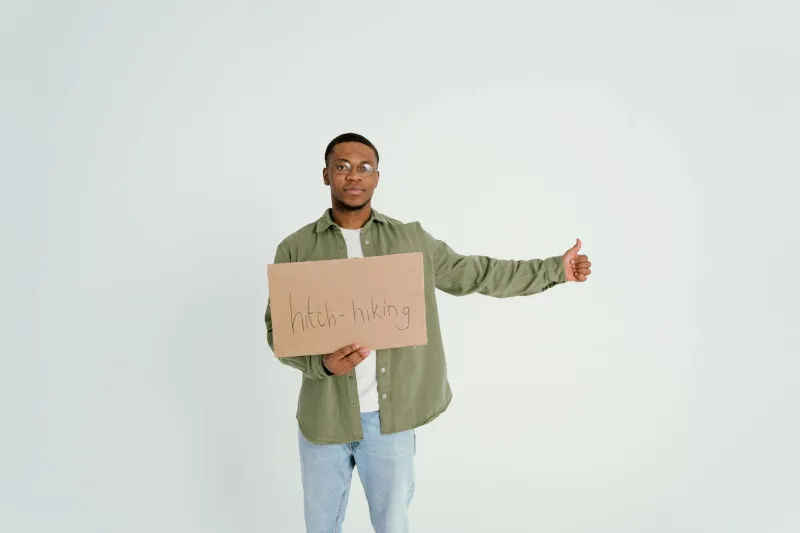
Picture this: you're running late for work in 1965, so you walk to the nearest highway onramp, stick out your thumb, and within minutes you're riding shotgun with a traveling salesman heading your direction. You chat about the weather, maybe share a cigarette, and he drops you off right at your office building. You thank him, he wishes you well, and you both go about your day.
Sound like science fiction? For most Americans today, it might as well be. But for the better part of four decades, this scenario played out millions of times across the country. Hitchhiking wasn't just accepted — it was woven into the fabric of how Americans moved around.
The Golden Age of Thumbing It
From the Great Depression through the late 1970s, hitchhiking was as American as apple pie. During World War II, the government actually encouraged it as a patriotic duty to conserve fuel and rubber. Posters proclaimed "When you ride alone, you ride with Hitler," and picking up hitchhikers became a way to support the war effort.
College students hitchhiked home for the holidays. Servicemen in uniform could count on rides from coast to coast. Workers without cars used their thumbs like a bus pass. Even middle-class families would pick up hitchhikers on long road trips — extra conversation helped pass the miles, and the hitchhiker might even chip in for gas.
The numbers were staggering. By some estimates, over 2.5 million Americans hitchhiked regularly in the 1970s. On any given day, you'd see them at highway onramps, truck stops, and city limits across the country — a diverse mix of students, workers, drifters, and anyone else who needed to get somewhere without a car.
More Than Just Transportation
Hitchhiking represented something deeper than just getting from point A to point B. It embodied a uniquely American optimism about human nature — the belief that most people were fundamentally decent and willing to help a stranger in need.
This trust went both ways. Drivers felt comfortable opening their doors to unknown passengers, while hitchhikers climbed into vehicles without knowing anything about who was behind the wheel. It was a social contract built on mutual faith in basic human goodness.
The practice also reflected the economic realities of the era. Cars were expensive, gas was cheap, and many Americans simply couldn't afford their own transportation. Hitchhiking filled a crucial gap in the mobility equation, especially in rural areas with limited public transit.
When the Music Died
So what killed off this American institution? The answer is complicated, involving everything from changing economics to shifting demographics to a few horrific crimes that captured national attention.
The 1970s brought a wave of highly publicized hitchhiker murders that dominated headlines and television news. Cases like the "Co-ed Killer" Edmund Kemper, who targeted young female hitchhikers in California, created a climate of fear that spread far beyond the actual risk.
Television and movies amplified these fears, portraying hitchhikers as either dangerous drifters or potential victims. The 1986 film "The Hitcher" crystallized the new cultural narrative: strangers on the highway were threats, not opportunities for human connection.
The Geography of Fear
But media coverage alone didn't kill hitchhiking. America's physical landscape was changing in ways that made the practice increasingly difficult and dangerous.
The Interstate Highway System, completed in the 1970s, created high-speed corridors where stopping for hitchhikers became genuinely hazardous. Unlike the older highway system with frequent towns and services, interstates encouraged non-stop driving through increasingly empty countryside.
Suburban sprawl meant more Americans lived in car-dependent communities where hitchhiking simply didn't make sense. Why thumb a ride to the mall when you needed a car to get anywhere once you arrived?
The Economics of Independence
Rising prosperity also played a role. As more families could afford multiple cars, the economic necessity that drove much hitchhiking began to disappear. Credit became easier to obtain, making car ownership accessible to groups who had previously relied on their thumbs.
At the same time, liability concerns made many drivers think twice about picking up strangers. Insurance companies and lawyers warned that giving someone a ride could expose you to lawsuits if something went wrong.
What We Lost Along the Way
By the 1990s, hitchhiking had essentially vanished from mainstream American life. Today, most people under 40 have never seen a hitchhiker, let alone picked one up or thumbed a ride themselves.
We gained safety and peace of mind, but we lost something too — a form of spontaneous human connection that once defined American mobility. The highway system that was supposed to bring us together instead became a place where we pass each other in isolation, sealed inside our individual metal capsules.
The death of hitchhiking reflects a broader transformation in American society, from a culture that defaulted to trust to one that defaults to suspicion. We've traded the risks and rewards of opening ourselves to strangers for the safety and loneliness of going it alone.
Next time you're driving down the highway and see an empty onramp where hitchhikers once waited hopefully, remember: this wasn't always a nation of strangers. There was a time when we were all just friends who hadn't met yet.