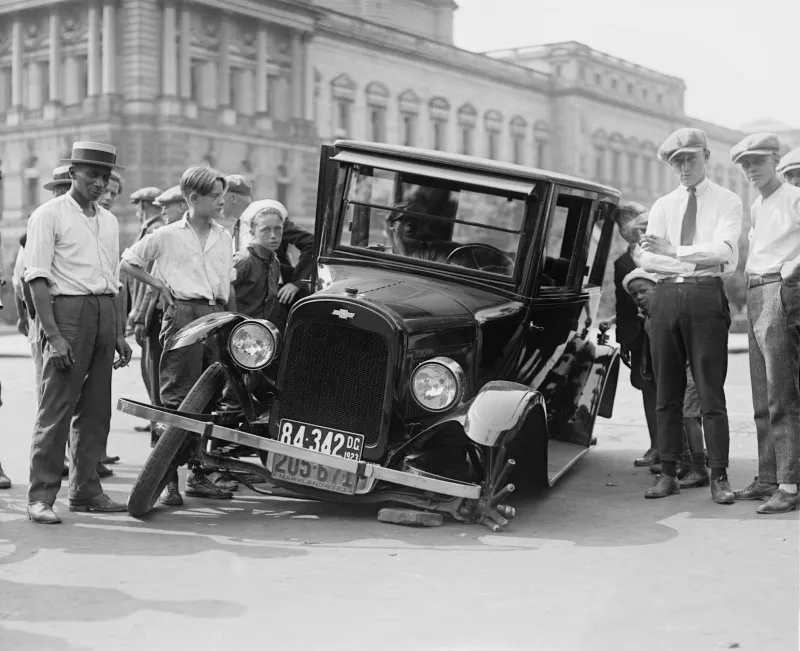
In 1925, if you backed into your neighbor's Model T, the conversation was straightforward: "Sorry about that, Bill. How much do you figure it'll cost to fix?" You'd shake hands on a number, maybe $15 for a new bumper, and that was that. No claim numbers, no adjusters, no six-month premium increases. Just two reasonable people solving a problem like adults.
Today, that same minor collision triggers an algorithmic avalanche. Your insurance company analyzes your credit score, cross-references your zip code's crime statistics, factors in your job title and marital status, then calculates a premium adjustment that might cost you hundreds of dollars annually for the next five years. What used to be a neighborly inconvenience has become a complex financial transaction managed by corporations that know more about your life than your family doctor.
The Handshake Era of Auto Insurance
For the first several decades of automotive history, car insurance was largely optional and remarkably simple. In the 1920s and 1930s, many states didn't require any coverage at all. Drivers who chose to buy insurance typically purchased basic liability policies for $25 to $50 annually—about $400 to $800 in today's money.
These early policies were bare-bones affairs. Coverage limits were low, deductibles were high, and the expectation was that you'd handle minor incidents yourself. Insurance was truly insurance—protection against catastrophic loss, not a comprehensive financial service covering every possible mishap.
The claims process reflected this simplicity. When accidents happened, drivers often settled small damages privately. For larger claims, insurance companies employed adjusters who made decisions based on straightforward assessments of fault and damage. There were no credit checks, no behavioral analysis algorithms, no consideration of whether you were single or married.
Premiums were calculated using basic factors: your age, your car's value, and your driving record. That was it. The idea that your insurance company would analyze your shopping habits, social media activity, or education level would have seemed absurdly invasive to drivers of that era.
The Mandatory Coverage Revolution
The transformation began in the 1970s as states started requiring minimum liability coverage. Massachusetts led the charge in 1927, but most states didn't follow until decades later. By 1975, nearly every state mandated some form of auto insurance, fundamentally changing the relationship between drivers and insurers.
Mandatory coverage created a captive market. Suddenly, every driver was required to purchase a product from a private company, whether they wanted it or not. This guaranteed customer base allowed insurance companies to expand their operations and develop increasingly sophisticated pricing models.
The shift from optional to mandatory coverage also changed consumer behavior. When insurance was voluntary, buyers shopped carefully and chose policies that matched their actual needs. When it became required, many drivers began viewing it as just another tax—a grudging expense rather than valuable protection.
This mandatory market created perverse incentives. Insurance companies no longer needed to compete primarily on value and service. Instead, they could focus on risk assessment and pricing optimization, using increasingly complex algorithms to maximize profits from their captive customer base.
The Algorithmic Invasion of Privacy
Modern auto insurance bears little resemblance to its straightforward predecessors. Today's insurers analyze dozens of factors that have nothing to do with driving ability but everything to do with statistical correlation and profit maximization.
Your credit score now plays a major role in determining your premium, based on insurance industry research showing correlation between credit ratings and claim frequency. Never mind that this connection might reflect economic stress rather than driving behavior—the algorithm doesn't care about causation, only correlation.
Where you live matters more than ever, but not just for obvious reasons like traffic density or weather patterns. Insurance companies now factor in neighborhood income levels, education rates, and even voting patterns when setting rates. Two identical drivers with identical records can pay vastly different premiums simply because one lives on the "wrong" side of town.
Your job title affects your rates, based on actuarial tables that assign risk levels to different professions. Apparently, journalists and artists are riskier drivers than accountants and engineers. Your marital status matters too—single people pay more than married couples, regardless of their actual driving habits.
Some insurers now offer "usage-based" programs that monitor your actual driving through smartphone apps or plug-in devices. While marketed as money-saving opportunities, these programs create detailed profiles of your daily movements, driving habits, and lifestyle patterns. The data they collect extends far beyond what's necessary to assess driving risk.
The Premium Explosion
The financial impact of these changes has been staggering. In 1975, the average American family spent about $400 annually on auto insurance (in 2024 dollars). Today, that number has more than tripled to over $1,400 annually, and in many states, it's significantly higher.
This increase far outpaces inflation and can't be explained solely by improved coverage or rising repair costs. Much of the increase reflects the insurance industry's evolution from a simple risk-pooling mechanism into a sophisticated profit-maximizing enterprise.
Modern policies also include numerous fees and charges that didn't exist in earlier eras. Processing fees, installment charges, policy fees, and various surcharges can add hundreds of dollars to annual premiums. What used to be a single annual payment has become a complex fee structure designed to maximize revenue.
The complexity of modern pricing makes it nearly impossible for consumers to understand what they're actually paying for. Premium calculations now involve so many variables that even insurance agents often can't explain why rates change from year to year.
The Claims Game Changes Everything
The claims process has become equally complex and adversarial. Where early insurance operated on good faith and straightforward assessments, modern claims handling involves extensive investigation, documentation, and negotiation.
Minor accidents that once resulted in simple repairs now trigger comprehensive investigations. Adjusters photograph everything, interview witnesses, and create detailed reports that become permanent parts of your insurance record. Even no-fault claims can affect your future rates, as insurers consider any interaction with their claims department a risk factor.
The rise of insurance fraud investigations has made the claims process increasingly suspicious and adversarial. Legitimate claims are scrutinized with the same intensity once reserved for obviously fraudulent ones. This defensive approach protects insurers from fraud but makes the experience frustrating and dehumanizing for honest customers.
Modern insurance companies also use claims data in ways that would have shocked earlier generations. A single claim can trigger rate increases that persist for years, turning insurance from protection into punishment. The message is clear: using your insurance will cost you, so think twice before filing a claim.
The Subscription Model Takeover
Perhaps the most fundamental change is how insurance companies view their relationship with customers. Early insurers sold policies—discrete products with defined terms and clear value propositions. Modern insurers operate more like subscription services, using continuous data collection and algorithmic adjustments to optimize ongoing revenue streams.
This shift reflects broader changes in the American economy, where many industries have moved from selling products to managing customer relationships. Your car insurance company doesn't just want to sell you a policy—it wants to become a permanent fixture in your financial life, adjusting rates continuously based on changing risk assessments and market conditions.
The subscription model also explains why modern insurance feels so intrusive. Companies need continuous data streams to feed their pricing algorithms, leading to increasingly sophisticated monitoring and analysis of customer behavior.
What We Lost in the Fine Print
The transformation of auto insurance from simple protection to complex financial product reflects broader changes in American economic life. We've gained sophisticated risk assessment and more precise pricing, but we've lost simplicity, privacy, and the sense that insurance companies are on our side.
The old system had flaws—rates were sometimes unfair, and coverage gaps left some drivers vulnerable. But it also had virtues that we've largely forgotten: transparency, simplicity, and respect for customer privacy.
Today's drivers face a system that knows everything about their lives but explains nothing about its decisions. We pay more for the privilege of being constantly monitored and analyzed, turning what should be straightforward financial protection into an ongoing relationship with corporate algorithms that judge our worthiness based on factors far beyond our control.
In gaining actuarial precision, we've lost the human element that once made insurance feel like genuine protection rather than sophisticated exploitation. The handshake deals of the past might have been imperfect, but at least both parties understood what they were agreeing to.