The Sweet Chaos of Not Knowing Where You Were Going: How America Lost Its Love Affair with Getting Lost
When Wrong Turns Were Right
Picture this: It's 1987, and you're driving through rural Montana with nothing but a gas station map and a vague sense that the interstate is "somewhere over there." Your companion is arguing about whether that last turn was the right one, the radio is crackling with static, and you haven't seen another car for twenty minutes. You're officially lost.
And you're having the time of your life.
This was the American road trip for generations of travelers — a beautiful dance with uncertainty that could lead you to a hole-in-the-wall diner serving the best pie you've ever tasted, or a scenic overlook that wasn't in any guidebook. Getting lost wasn't a failure; it was an integral part of the journey.
The Art of Creative Navigation
Before smartphones put a GPS in every pocket, navigation was part skill, part guesswork, and part art. Travelers developed an almost mystical relationship with their surroundings. You learned to read the landscape — mountains meant you were heading west, the sun's position told you it was time to start looking for a motel, and the density of billboards indicated how close you were to civilization.
Gas station attendants were unwitting travel consultants, dispensing directions with the confidence of seasoned explorers. "Head down this road until you see the red barn, then hang a left at the place where the old Miller farm used to be." These directions were wonderfully imprecise, leaving plenty of room for interpretation and, inevitably, adventure.
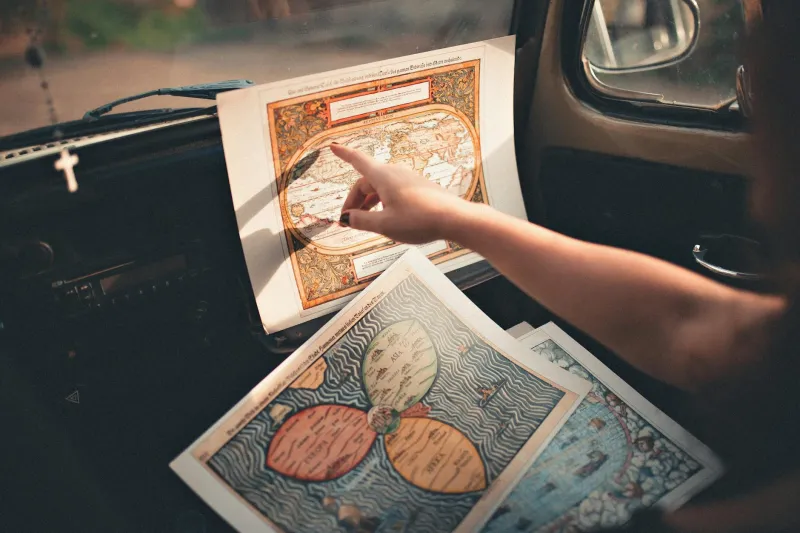
Folded paper maps became sacred objects, worn soft at the creases from constant use. Reading them required genuine skill — understanding scale, interpreting symbols, and most importantly, accepting that the map was just a suggestion. Reality on the ground often told a different story, especially when road construction or seasonal closures threw your carefully planned route into chaos.
The Economics of Wandering
Getting lost had real consequences that shaped how people traveled. Without the ability to instantly locate the nearest gas station, travelers learned to fill up whenever they saw a pump. Running out of fuel in the middle of nowhere wasn't just inconvenient — it could be genuinely dangerous.
This uncertainty created a different relationship with money and planning. You couldn't simply search for "cheap hotels near me" at 9 PM and find three options within five miles. Instead, you learned to spot the telltale signs of lodging — neon vacancy signs, clusters of motels near highway exits, or simply pulled over to ask at a local diner where a traveler might find a clean room for the night.
The unpredictability meant budgeting for the unexpected. That wrong turn might add fifty miles to your journey, burning through gas money you'd earmarked for souvenirs. Or it might lead you to a family-run restaurant where the portions were huge and the prices were from another era.
The Social Currency of Being Lost
Asking for directions was a social ritual that connected strangers in ways we've largely forgotten. Every interaction was a small human moment — the helpful local who drew a map on a napkin, the fellow traveler at a rest stop who shared intel about road conditions ahead, or the motel clerk who recommended a shortcut that would save you an hour.
These encounters weren't just transactional; they were cultural exchanges. You learned about local customs, heard stories about the area's history, and got recommendations that no guidebook could provide. Getting lost forced you to engage with the places you were passing through, rather than simply passing over them.
The Death of Serendipity
Today's GPS-guided journeys are marvels of efficiency. You know exactly when you'll arrive, which route will save you the most time, and where to find the cheapest gas along the way. Traffic jams are anticipated, alternate routes are calculated instantly, and wrong turns are corrected before you've traveled more than a few hundred yards off course.
But something profound has been lost in translation. Modern road trips have become exercises in optimization rather than exploration. We've gained certainty and lost surprise. The algorithm knows the fastest route, but it doesn't know about the antique shop that's only open on weekends, or the scenic detour that's worth an extra hour of driving.
What We Traded Away
The shift from analog uncertainty to digital precision happened gradually, then all at once. First came MapQuest printouts — a hybrid approach that gave you the route but still left room for interpretation. Then GPS devices appeared, expensive gadgets that spoke directions in robotic voices. Finally, smartphones made navigation so seamless that getting lost became almost impossible.
With each technological advance, we gained convenience but lost something harder to quantify. The stories we tell about old road trips are rarely about the efficient routes we took or the time we saved. Instead, we remember the detours, the discoveries, and yes, the times we got completely, wonderfully lost.
The Road Less Algorithmic
Some travelers today deliberately turn off their GPS, seeking to recapture that sense of adventure. But it's not quite the same. The safety net is still there — one touch of a screen can instantly reveal your location and plot a course home. The stakes aren't as high, and neither is the payoff.
The era of truly getting lost is over, relegated to history alongside other obsolete travel experiences like needing film for your camera or calling ahead to make hotel reservations. We've optimized the journey, but in doing so, we've optimized away some of its magic.
In our rush to never be lost again, we may have lost something even more valuable — the willingness to not know where we're going and to be delighted by where we end up.