Fort Knox Restrooms: When Gas Station Bathrooms Required a Security Clearance
The Dawn of Bathroom Paranoia
Somewhere between the Eisenhower administration and the Clinton years, America decided that strangers couldn't be trusted with unsupervised access to a toilet. What started as simple courtesy — unlocked restroom doors at every gas station from Maine to California — morphed into an elaborate security theater involving keys attached to objects so large you'd need a sherpa to carry them.
In the 1950s and 1960s, gas station restrooms operated on pure faith. Doors stayed unlocked during business hours. The worst thing that might happen was someone leaving the seat up or forgetting to replace the toilet paper. Station owners treated their facilities as a public service, understanding that a clean, accessible bathroom was part of hospitality that kept customers coming back.
Enter the Era of the Giant Key
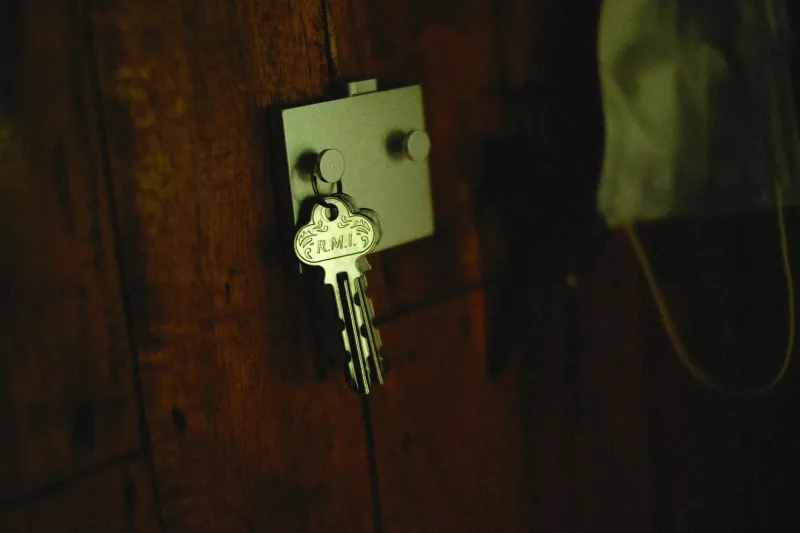
By the 1980s, everything changed. Suddenly, every Texaco and Shell station armed their restroom keys with wooden paddles, metal hubcaps, or concrete blocks. The message was clear: we'll let you use our bathroom, but we're going to make sure you come back with our key. These weren't subtle deterrents — they were psychological warfare disguised as loss prevention.
The oversized key phenomenon reached peak absurdity when some stations began chaining their keys to bowling balls, car tires, or custom-made wooden blocks shaped like miniature outhouses. The implicit assumption was that every customer was a potential thief, one bathroom visit away from making off with a 25-cent brass key.
The Trust Deficit
What drove this shift wasn't really about key theft — it was about control and liability in an increasingly litigious society. Station owners worried about drug use, vandalism, and liability issues. The giant key became a screening mechanism, forcing customers to interact with an employee and implicitly agree to responsible behavior.
This represented a fundamental change in how Americans viewed public spaces. The open bathroom door symbolized community trust; the fortress key system revealed growing paranoia about stranger danger. Gas stations went from being community gathering spots to transactional pit stops where every interaction required security protocols.
The Digital Fortress
Today's gas station bathroom experience makes the wooden paddle era look quaint. Many stations have abandoned keys entirely, opting for digital codes that change daily, app-based unlocking systems, or employee-only access. Some high-tech locations require customers to scan their gas receipts or input purchase codes to gain entry.
Wawa pioneered the receipt-code system, where your bathroom access depends on proving you're a paying customer. Sheetz locations often require asking an employee to buzz you through electronically. The human interaction that once made road trips feel neighborly has been replaced by algorithms and access controls.
What We Lost Along the Way
The transformation of gas station restroom access mirrors broader changes in American social fabric. Those unlocked doors represented an era when communities operated on default trust rather than default suspicion. Station attendants knew their regular customers by name. Travelers felt welcomed rather than surveilled.
The giant key era served as an awkward middle ground — maintaining some human interaction while acknowledging that trust had eroded. At least you could still ask Earl behind the counter for the restroom key and maybe get directions to the best diner in town while you were at it.
The Antiseptic Present
Modern gas station chains have solved the bathroom problem through sterile efficiency. QR codes replace human interaction. Automated systems eliminate the need for trust entirely. The experience is frictionless but completely impersonal — you can relieve yourself without ever acknowledging another human being exists.
Some newer stations have eliminated public restrooms altogether, directing customers to nearby McDonald's or Walmart locations. Others have gone full fortress mode, requiring purchases above a certain amount or membership in loyalty programs. The simple act of using a bathroom while traveling has become a privilege rather than a basic courtesy.
Reflections on Progress
The evolution from open doors to digital fortresses tells a story about more than bathroom access — it's about how America gradually abandoned the assumption that strangers deserve basic trust. Every security measure added to restroom access represented another small retreat from community-minded thinking.
Today's travelers might appreciate not having to lug a cinder block to the bathroom, but they've lost something harder to quantify: the feeling that they're welcome in unfamiliar places, that someone trusts them enough to leave a door unlocked. The gas station bathroom, once a symbol of American road hospitality, became a monument to our collective trust issues.
Progress gave us cleaner facilities and better security, but it cost us the simple dignity of being trusted with a bathroom key that fit in your pocket.